


Made in Italy grows almost four times faster than the national export average
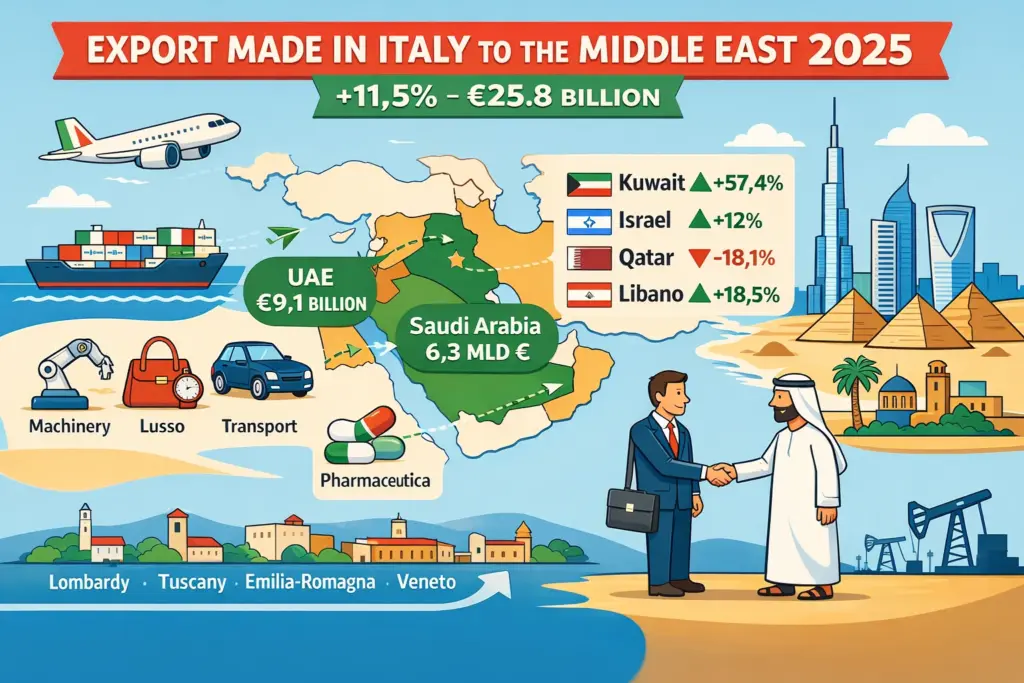
Italian exports to the Middle East recorded strong growth in 2025, confirming the region as one of the most dynamic markets for Made in Italy products.
According to an analysis by the Unimpresa Research Center, exports to thirteen countries in the extended Middle East reached €25.8 billion, up from €23.2 billion in 2024, marking an increase of +11.5%.
This performance is almost four times higher than the overall growth of Italian exports, which rose by only +3.1%during the same period.
Table of Contents
- A strategic region for Italian companies
- UAE leads the region
- Saudi Arabia and Kuwait boost industrial demand
- Sector composition of exports
- Outlook for 2026
A strategic region for Italian companies
The region includes the six Gulf countries (United Arab Emirates, Saudi Arabia, Kuwait, Qatar, Oman and Bahrain) as well as Israel, Lebanon, Jordan, Syria, Egypt, Libya, Iraq and Iran.
Together, these markets now represent 4.6% of Italy’s manufacturing exports, up from 4.2% in 2024.
Two structural drivers support this growth:
- massive infrastructure investment programs in Gulf countries
- the rapid expansion of a high-income consumer class seeking premium goods.
According to Unimpresa vice president Giuseppe Spadafora, the region offers strong opportunities for Italian companies.
“Middle Eastern markets continue to represent an important opportunity for Italian industry. Even amid geopolitical tensions, demand for Italian technology, infrastructure and high-quality goods remains strong and structural.”
UAE leads the region
The United Arab Emirates remain the leading destination for Italian exports in the region, accounting for more than one-third of total exports.
In 2025, exports to the UAE reached €9.1 billion, up 18.6% compared to €7.7 billion in 2024.
Dubai acts as a major re-export hub, redistributing Italian goods to other Middle Eastern and Asian markets.
Saudi Arabia and Kuwait boost industrial demand
Saudi Arabia ranks second, with €6.3 billion in Italian exports, up 3.7% year-on-year.
Meanwhile, Kuwait recorded the strongest growth, reaching €1.9 billion, an increase of 57.4% compared with 2024.
The surge was mainly driven by:
- transport equipment
- industrial machinery
- metallurgical products.
Sector composition of exports
The leading sector remains industrial machinery, worth €7 billion, accounting for 24.2% of total exports to the region.
Other major sectors include:
- luxury consumer goods (jewelry, leather goods, eyewear)
- transport equipment
- chemical and pharmaceutical products
- fashion and textiles.
Outlook for 2026
The main risk for the coming year comes from rising geopolitical tensions in the Persian Gulf.
Before the crisis, around 40% of Italian container exports passed through the Hormuz-Suez corridor.
Shipping disruptions have increased transit times by 10–14 days and pushed freight costs up by 30–35%.
A rapid de-escalation could preserve the current growth trend, while a prolonged conflict might significantly reduce trade flows.
This post is also available in: